

ODOR-SIGHT
Predict odorant molecules
with explainable AI
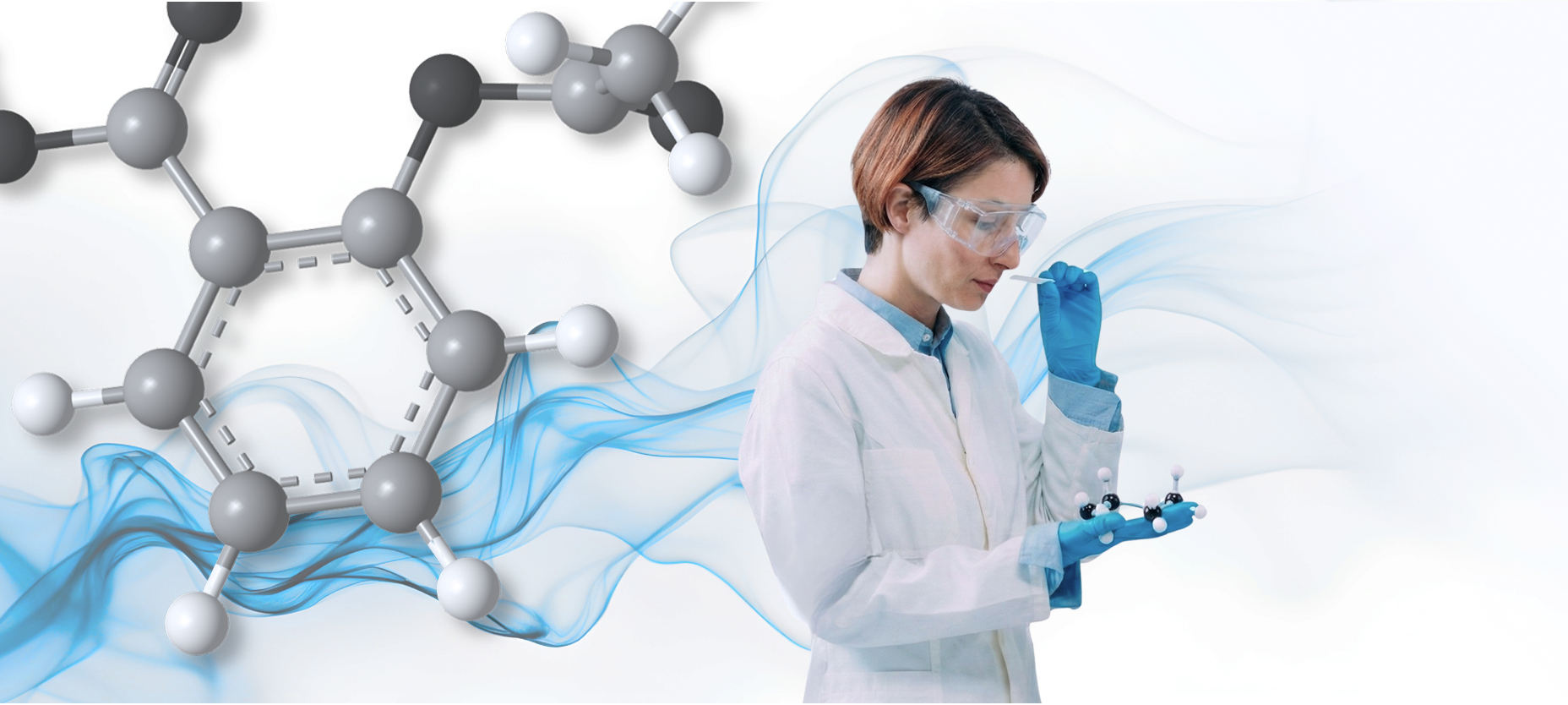
Deep learning web server using Graph Attention Networks to classify molecules as odorant or odorless with 94%+ accuracy and bond‑level explanations.
ODOR-SIGHT
Predict odorant molecules with explainable AI
Deep learning web server using Graph Attention Networks to classify molecules as odorant or odorless with 94%+ accuracy and bond‑level explanations.
The architecture
ODOR-SIGHT represents molecules as graphs — atoms as nodes, bonds as edges — and applies multi-head attention to capture complex structural patterns relevant to olfaction. Each atom encodes 45 features including atomic properties and physicochemical descriptors; each bond encodes 11 features capturing bond type, stereochemistry, and conjugation.
Interpretability
EdgeSHAPer provides bond-level Shapley value explanations, revealing which chemical bonds drive each prediction. The density-based applicability domain flags molecules outside the training chemical space, ensuring transparent and reliable results for research in chemistry, neuroscience, and fragrance development.

GRAPH ATTENTION NETWORK
ODOR-SIGHT uses a Graph Attention Network (GAT) where molecules are graphs of atoms and bonds. Nodes encode atomic properties (type, hybridization, aromaticity) and descriptors like LogP and Gasteiger charges. Multi-head attention dynamically weights atom neighborhoods for rich structural learning.
HIGH ACCURACY
Powered by an optimized GATv2 with 4 layers, ODOR-SIGHT exceeds 0.94 Balanced Accuracy (BACC) on external validation. The model learns from 45 node and 11 edge features, rigorously validated on independent test sets to ensure reliable generalization.
CURATED OLFACTION DATA
Our training dataset comprises carefully curated olfaction data from established databases. Each compound is validated for odorant or odorless classification, providing a robust foundation for model training and reliable predictions.
EDGESHAPER EXPLANATIONS
EdgeSHAPer explains predictions by quantifying each bond's contribution via Shapley values. View bond importance heatmaps, identify key influential bonds, and explore pertinent positive sets—the smallest subsets sufficient to maintain the prediction.
APPLICABILITY DOMAIN
ODOR-SIGHT assesses reliability using a density-based Applicability Domain. Molecular embeddings are projected via PCA and evaluated with Kernel Density Estimation. Molecules above the 5th percentile threshold are 'In Domain'; others are flagged as novel/less reliable.
OECD COMPLIANT
ODOR-SIGHT follows OECD QSAR guidelines, including defined endpoints, unambiguous algorithms, applicability domain characterization, and mechanistic interpretation, ensuring robust and regulatory-ready predictions.
Odor-Sight · Predictor
Instructions
Draw a substance or paste a smiles string
Draw the chemical structure of the compound you want to evaluate using the drawing tool provided in the app. Alternatively, you can paste a SMILES string of the compound into the drawer. You can review and edit it if necessary.
Or upload a single SDF / MOL file
Use the editor's load button to import one curated structure from an SDF or MOL file (max 2 MB). The editor reads the file in your browser and loads a single molecule onto the canvas. ODOR-SIGHT predicts one molecule per submission. See the data-handling notice below for details on curation and privacy.
Hit the prediction button and wait in queue
Once you have drawn the structure, click 'PREDICT'. Requests are processed via Fair Queuing, so it may take some time depending on server load. Please wait and do not close the page.
Review the results and download the report
After the prediction is complete, you will see the results including the classification (odorant or odorless), confidence score, applicability domain analysis, and EdgeSHAPer explanations. You can download a detailed PDF report.
Before you submit
Data handling, curation & privacy
A short, honest note on what ODOR-SIGHT does and does not do with the chemistry you submit. Please read before running predictions on novel structures.
ODOR-SIGHT does not perform full chemical standardization on submitted structures. Before predicting, please curate your inputs: remove counter-ions and salts, neutralize charges where appropriate, and select a canonical tautomer. The server applies only basic RDKit canonicalization on the SMILES it receives. Downstream predictions and applicability-domain checks are sensitive to the exact form you submit.
If RDKit cannot parse your structure (malformed SMILES, broken valences, exotic atoms outside the model's training distribution), the request fails with an error message. Always sanity-check inputs in a chemistry editor before submitting. For parseable but chemically unusual molecules, predictions are still returned. Use the Applicability Domain panel in the results to judge whether the prediction is trustworthy.
We do not persist your submitted SMILES, SDF, or MOL data. To accelerate repeated queries we cache results in Redis keyed only by a SHA-256 hash of the canonical SMILES, with a 7-day expiry. The original structure is never written to disk on our side. You can submit novel chemistry with confidence.
The free ODOR-SIGHT web server predicts a single molecule per submission. SDF and MOL files are read in your browser by the chemistry editor, which loads one structure at a time onto the canvas, so any uploaded file is treated as a single-molecule request. Multi-molecule batch prediction will be available exclusively through our upcoming commercial offering, Insight AI Pro. For early access and pricing, please contact us at carolina@ufg.br.